Every single week without fail we hear about clients who’ve spent hundreds or thousands of dollars on the latest “miracle” hair serum that promises to finally cure their hair loss. They come in with a shelf full of products, a routine they have followed faithfully, and still, more hair in the brush than they want to see.
Clients are trying, but most options in front of them fall into two familiar camps. On one side, there are drug-based options like minoxidil. They have recognition, but not every client wants to commit to a drug-based routine, especially when concerns around irritation, shedding phases or other side effects come up.
On the other side, there are plant-based cosmetic serums like Vegamour. These products feel approachable and speak the language clients want to hear. The question we hear in the chair is more specific. If there’s less hair in the brush, should the part look fuller, too?
“The branding has gotten slicker: ‘science-backed,’ ‘clinically tested,’ ‘clean,’ or things like ‘plant-powered’. But the actual impact at the hair stays surface-level, at best. It’s there for the clients to feel reassured.”
— Lucia Vargas, celebrity colorist
Recently, a new non-drug approach has been making waves in our community. A research group has been studying molecules that act on the follicle and its surrounding environment. RE:YOU uses three of those molecules in its Dual-Path Hair Revival Serum. The technology is called NOVOGRO™.
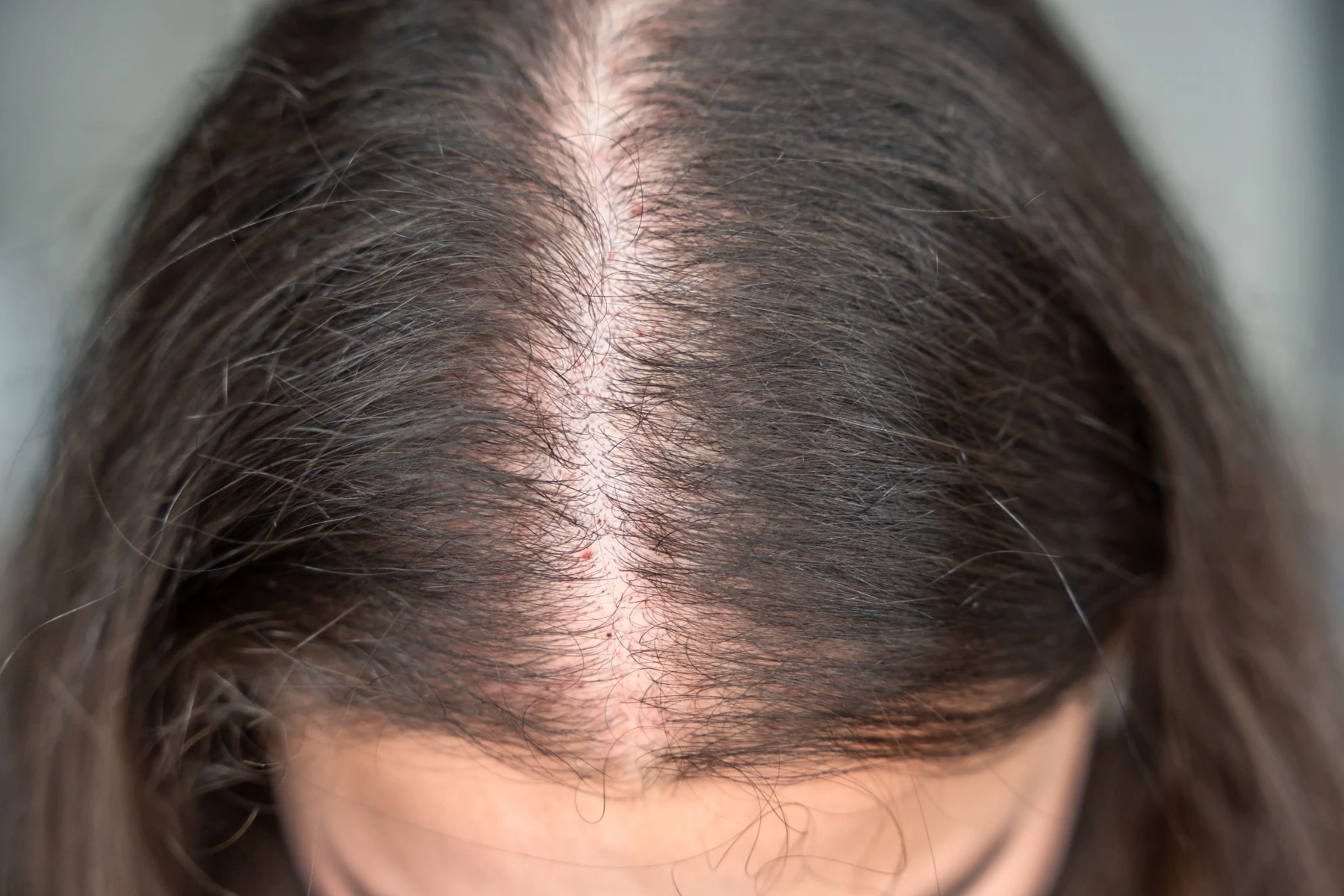
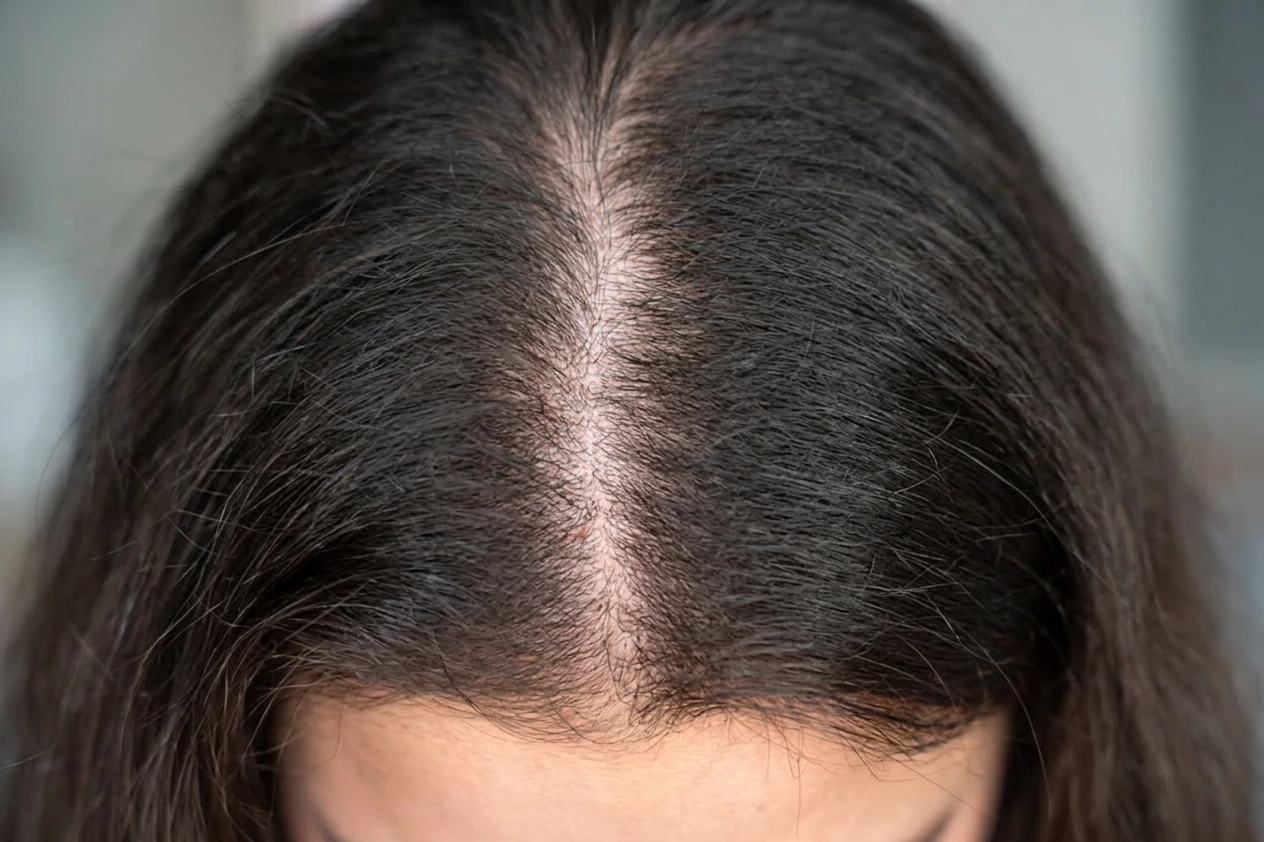
One stylist in our network used a NOVOGRO™-powered serum and shared these progress photos with us. The center part appears narrower in the second photo. The lighting and angle differ, so we can’t use the pair to measure a change in density.
Hair Loss Is Complicated
A client comes in after using Vegamour’s serum consistently for four months. She says, “I think I’m shedding a little less.” And that may be true. But when we section the hair under salon lighting, the bigger picture has not shifted much. The temple area may have a few short, wispy hairs that still need time to mature, but the part line is still open, the density has not visibly filled in, and the overall hair mass looks largely the same.
That is where we have to separate reduced shedding from a change in density. One counts the hairs coming out. The other counts how many are growing in a given area of scalp. When the brush is the first clue, our chairside guide to shedding and breakage explains what to look for.
Hair growth sounds simple when we explain it to clients. A strand grows, rests and eventually sheds. But neighboring follicles can be at different points in that cycle. That’s why a client may notice less hair in the shower before she can see any difference along her part.
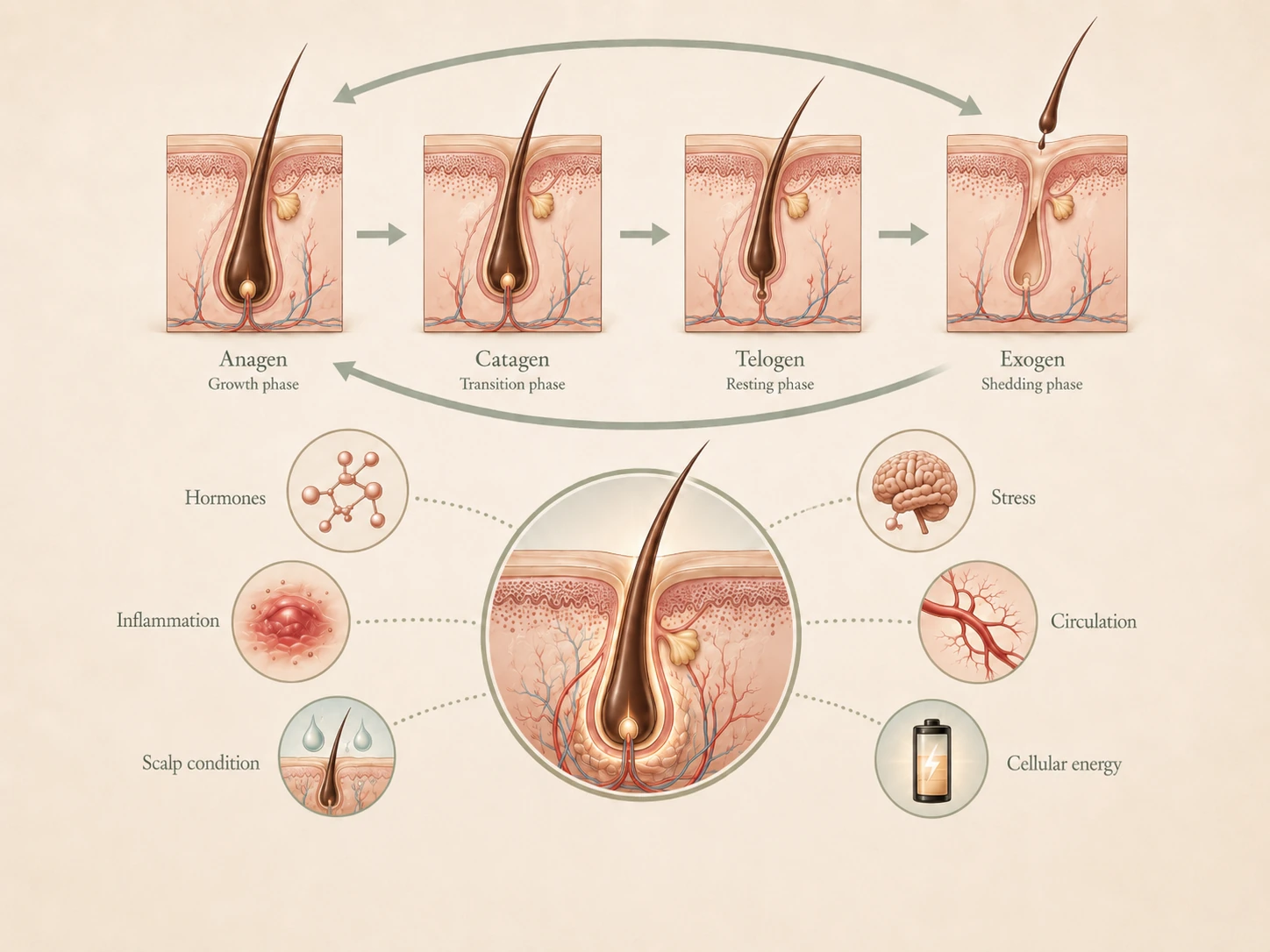
That is why we get cautious when a product tells too neat of a story.
What Vegamour’s GRO Hair Serum Was Tested For
Vegamour is a good example. Its GRO Hair Serum is a lightweight daily scalp serum. The ingredient list includes mung bean and red clover sprout extract, caffeine and peptides. For a client who wants a step she can keep up with between appointments, how it feels on the scalp matters.
But the issue is specificity. Vegamour asked 40 people to use GRO Hair Serum daily for 120 days. In the brand’s consumer perception study, 93% said they noticed less shedding, 90% thought their hair looked better and 83% felt their hair was stronger. Those responses tell us what participants noticed. The survey gives us no count of how many hairs grew in a measured patch of scalp.
“Clients hear ‘clinically tested’ and assume the product is built to reverse thinning. In reality, many cosmetic serums are designed to support the scalp and improve the look and feel of the hair. That can have value, but it is not always enough when a client is dealing with a visible loss of density.”
— Sophie Lane, women’s hair-thinning consultant
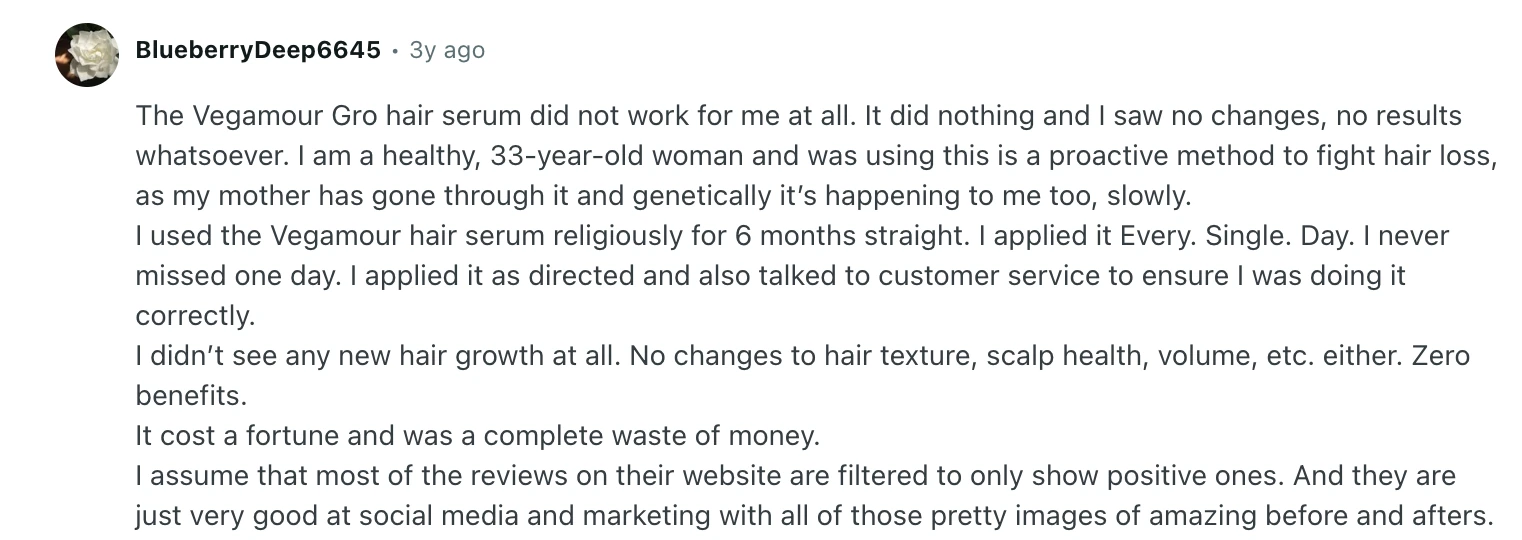
A review can help us ask better questions in a consultation. This one tells us how one person experienced the serum. The percentage of clients who can expect a change in density is a separate question.
NOVOGRO™ and Follicle Biology
The scientists behind NOVOGRO™ started by looking at signals that help a follicle grow. In their preprint, they describe studying cells at the base of the follicle, called dermal papilla cells. Those cells send signals that help regulate a hair’s growth cycle. The researchers also looked at how surrounding cells respond to oxygen and at an enzyme involved in making DHT, a hormone linked to pattern thinning.
For a stylist, the interesting part is how they followed up. Once they had a formula, they could put it alongside familiar serums and watch what happened in the same model.
What the Lab Data Showed
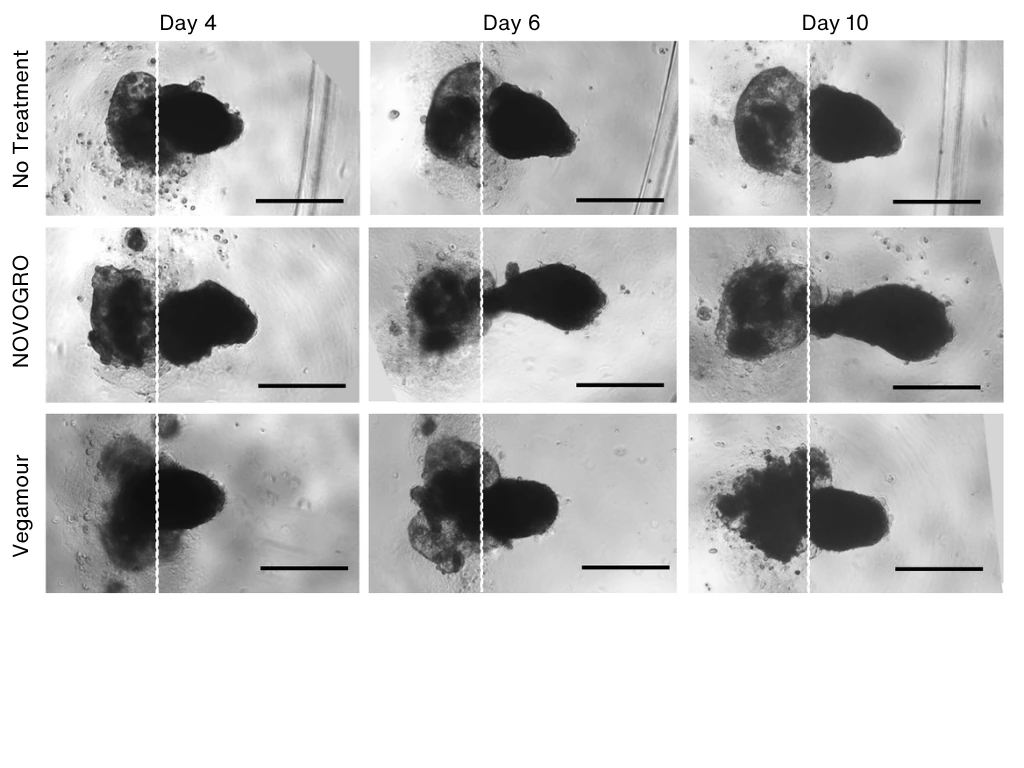
In the NOVOGRO™ study, the researchers used cells from human hair follicles to build a miniature follicle-like model in the lab. Think of it as a simplified version of the follicle environment in your scalp. With the right conditions, these follicle-like structures respond to growth signals and begin to elongate, which gives researchers a way to see whether a treatment is actually encouraging follicle activity.
The researchers compared the length of the model’s outgrowth on day 10 with its length on day 0. The NOVOGRO™ formula reached about 2.4× its starting length. Vegamour GRO Hair Serum reached about 1.5×, close to the control at 1.6×. Each number uses the same starting point of 1×.
Preclinical comparison
How far did the model grow by day 10?
Outgrowth length as a multiple of its day-0 length
These results tell us how the formulas behaved in a lab-grown model. To answer the question we hear at the salon about a widening part, we also want to see what changed on people’s scalps.
What Changed on Real Scalps at 90 Days?
RE:YOU’s clinical study enrolled 190 women ages 35–70 with mild to moderate female pattern hair loss. Researchers randomly assigned participants to the finished NOVOGRO™-powered serum or topical minoxidil. Participants and evaluators were blinded. The six-month study had two active treatment groups and no placebo group.
The brand’s 90-day interim report covers the majority of study sites. Researchers counted shed hairs after standardized combing and measured density using scalp images. RE:YOU reports the following results for its serum group.
RE:YOU serum group at day 90
Shed fewer hairs
Share of participants assessed by comb test
Average shedding
Change from the group’s starting level
Hair density
Change from the group’s starting level
Brand-reported interim results. Study methods and shedding results · Density result
RE:YOU reports that the reduction in shedding was 44% greater than in the minoxidil group. That comparison is specific to shedding at 90 days. Vegamour was included in the laboratory comparison only, so these trials cannot tell a client which of the two serums would give her more density.
So… What Are You Actually Looking For?
What a client asks
“Did people notice less shedding?”
Vegamour GRO Hair Serum
In a 120-day survey, 93% said yes.
RE:YOU serum with NOVOGRO™
At 90 days, a standardized comb test recorded fewer shed hairs for 97% of the RE:YOU group.
What a client asks
“Did anyone measure density?”
Vegamour GRO Hair Serum
The consumer survey reports how hair looked and felt.
RE:YOU serum with NOVOGRO™
RE:YOU reports an 18% increase from baseline using scalp imaging.
What a client asks
“Were these two serums tested together?”
Vegamour GRO Hair Serum
Both formulas were tested in the same lab-grown follicle model.
RE:YOU serum with NOVOGRO™
The human trial used topical minoxidil as its comparator.
| What a client asks | Vegamour GRO Hair Serum | RE:YOU serum with NOVOGRO™ |
|---|---|---|
| “Did people notice less shedding?” | In a 120-day survey, 93% said yes. | At 90 days, a standardized comb test recorded fewer shed hairs for 97% of the RE:YOU group. |
| “Did anyone measure density?” | The consumer survey reports how hair looked and felt. | RE:YOU reports an 18% increase from baseline using scalp imaging. |
| “Were these two serums tested together?” | Both formulas were tested in the same lab-grown follicle model. | The human trial used topical minoxidil as its comparator. |
Both have a place. If a client tells us she’s seeing less hair in her brush, that’s worth hearing. If she wants to know whether her part is filling in, we can show her how density was measured, what changed by day 90 and how much remains open until longer follow-up. She can see the formula in RE:YOU’s Dual-Path Hair Revival Serum and the measurements behind it in the clinical report.
That is the difference we are all watching play out in the chair.
References & Sources
- 1.Qu Z and colleagues. AI-enabled discovery of small molecules targeting complementary pathways for hair follicle rejuvenation. bioRxiv preprint, 2026. Laboratory comparison.
- 2.Vegamour. GRO Hair Serum and 120-day consumer study.
- 3.RE:YOU. Clinical trial design and interim 90-day results.
- 4.RE:YOU. Science and measured changes in hair density and shedding.