
Hair loss is not a cute wellness topic in the salon. It changes the consultation, the haircut, the color plan, the client’s mood, and the photos they suddenly do not want taken.
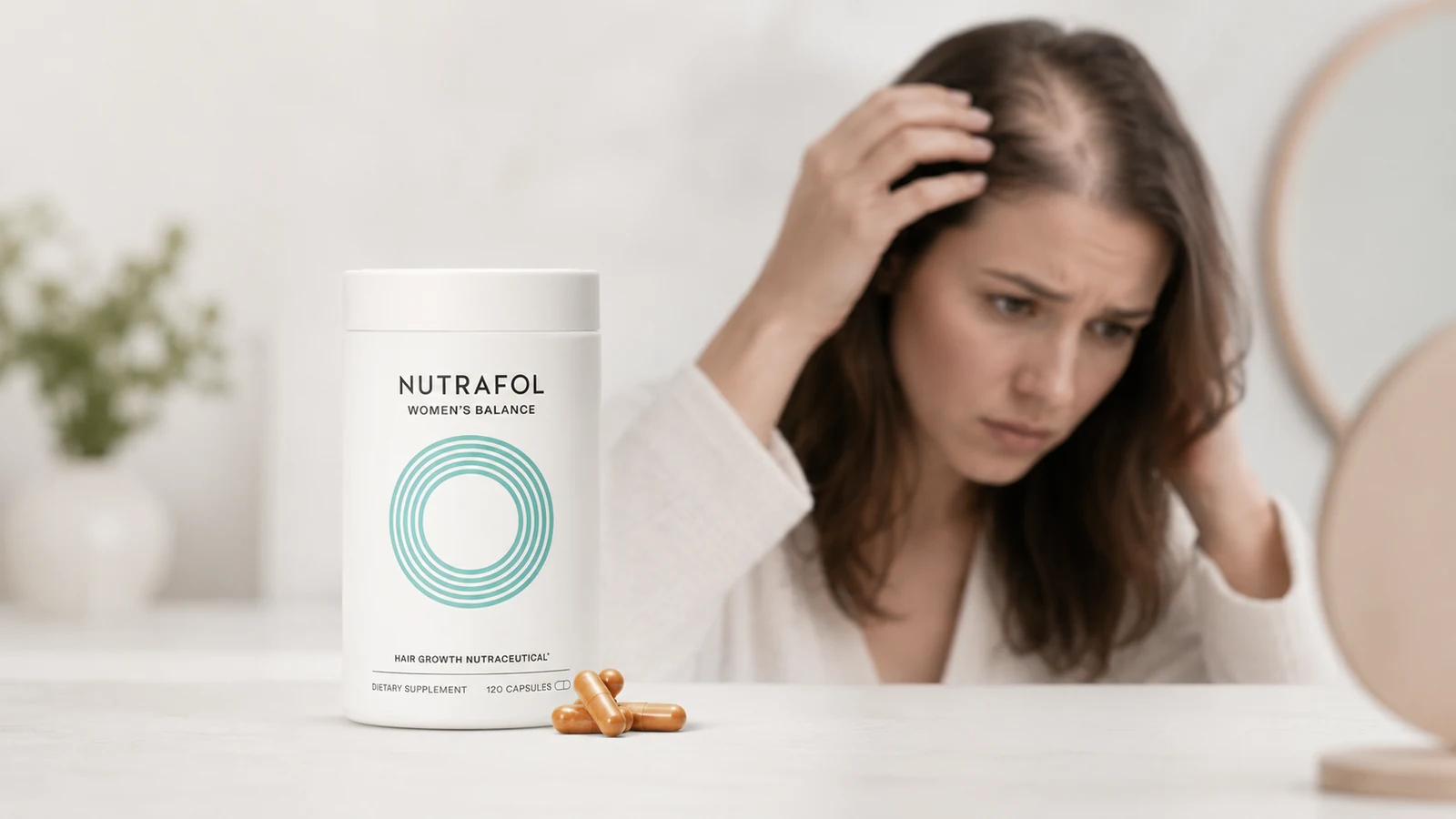
And lately, one name keeps coming up: “I started Nutrafol.”
Of course they did. It is everywhere. Dermatologists mention it. Influencers post it. Clients see it online enough times and assume it must be the gold standard.
That is where stylists need to be sharper.
A product can be famous and still not be the right tool for the job. Visibility is marketing. Results are biology.
Nutrafol has a place. It is a premium supplement with clinical support and a polished wellness story. For some clients, especially those dealing with mild shedding, stress, or nutrition-related hair changes, it may be useful.
But when the client is staring at a widening part, weaker density, finer regrowth, or pattern thinning around the crown and hairline, we need to stop acting like a supplement stack is the same thing as follicle-level science.
Nutrafol Is a Supplement. Let’s Call It What It Is.
Nutrafol was founded in 2014 by Giorgos Tsetis and Roland Peralta, and Unilever announced in 2022 that it would acquire a majority stake in the company. That gave Nutrafol major beauty-industry reach.
The core Nutrafol idea is “hair wellness from within.” Its formulas include ingredients like ashwagandha, marine collagen peptides, saw palmetto, curcumin, tocotrienol complex, biotin, vitamins, minerals, and other botanical or nutraceutical ingredients. Nutrafol frames the product around “root causes” of thinning, including stress, hormones, lifestyle, nutrition, metabolism, and aging.
That sounds strong on a bottle, but clients should understand it is a branded mix of fairly common supplement ingredients with no one single breakthrough molecule.
What the Main Ingredients Are Meant to Do
Key ingredient
Saw palmetto
What it is supposed to do
Helps reduce DHT activity naturally by blocking 5-alpha reductase, the enzyme involved in converting testosterone into DHT.
Why it may not be enough
Weaker than pharmaceutical DHT blockers like finasteride or dutasteride. Also not recommended during pregnancy.
Key ingredient
Ashwagandha
What it is supposed to do
Targets stress and cortisol, which may help with stress-related shedding.
Why it may not be enough
Only useful if stress is a major driver. It will not solve pattern thinning or follicle miniaturization by itself.
Key ingredient
Marine collagen
What it is supposed to do
Provides amino-acid building blocks that support hair structure.
Why it may not be enough
Many people already get enough collagen support from diet. Also not suitable for people with fish allergies.
| Key ingredient | What it is supposed to do | Why it may not be enough |
|---|---|---|
| Saw palmetto | Helps reduce DHT activity naturally by blocking 5-alpha reductase, the enzyme involved in converting testosterone into DHT. | Weaker than pharmaceutical DHT blockers like finasteride or dutasteride. Also not recommended during pregnancy. |
| Ashwagandha | Targets stress and cortisol, which may help with stress-related shedding. | Only useful if stress is a major driver. It will not solve pattern thinning or follicle miniaturization by itself. |
| Marine collagen | Provides amino-acid building blocks that support hair structure. | Many people already get enough collagen support from diet. Also not suitable for people with fish allergies. |
It is taken orally to support the internal factors that may influence hair growth over time. A supplement depends on absorption, baseline nutrition, and whether the client actually needed that support in the first place.
There is a lot of “maybe” for someone already panicking about her hair. If a client is dealing with progressive pattern thinning, follicle miniaturization, or a more advanced density loss issue, they want more than a wellness capsule and a prayer.
The Evidence Is Real, But Don’t Oversell It
Nutrafol does have clinical studies and peer-reviewed publications, which puts it ahead of many beauty supplements. One of its stronger studies was a six-month, placebo-controlled trial that showed improvement in terminal and total hair counts by J Drugs Dermatology in 2021.
That said, the evidence still needs context.
Where the Evidence Needs Context
A lot of the research has been sponsored by Nutraceutical Wellness, the company behind Nutrafol. We would feel better seeing larger, independent studies.
Some of the brand-facing results it cited also lean heavily on perception-based outcomes. One example is the 2022 Journal of Clinical and Aesthetic Dermatology study that Nutrafol references, where participants reported improvements in hair growth and shedding. That sounds promising, but feeling better about your hair is not always the same as seeing real density come back. Hope is not a measurement. Plus, the study did not include a placebo control group.
Another practical issue is baseline nutrition. A supplement can look stronger when it is correcting a real deficiency. If the client was already nutritionally fine, the effect may be much less dramatic.
So the fairest salon read is this: Nutrafol has evidence for mild to moderate support in some users, but it is not a guaranteed density transformation, and it should not be treated like one.
The Cost Issue and Side Effects
Nutrafol is also a real budget commitment. The review we looked at puts it around $70 to $80 a month, which can add up to $800 or more a year. If you are already stretching your budget, it is worth knowing that some store-brand options use similar ingredient categories, although the exact blends and ratios are not the same.

The Side Effects Clients Should Know About
Nutrafol is usually well tolerated, but “natural” does not mean invisible to the body. Some clients report stomach upset, nausea, cramping, or digestive discomfort. That is not shocking with a large multi-ingredient supplement.

More Vitamins Are Not Always Better
The other thing I would tell clients is this: more vitamins are not always better. Nutrafol has a long ingredient list, and some nutrients can be an issue if you are already getting enough from food or other supplements.
Nutrient
Vitamin D
Why more is not always better
Too much can affect calcium levels.
Nutrient
Vitamin A or selenium
Why more is not always better
Excess intake has been linked with shedding.
Nutrient
Iodine
Why more is not always better
Too much can disrupt thyroid balance, which may contribute to diffuse hair loss; it may also affect hormones or trigger acne.
Nutrient
Zinc
Why more is not always better
Too much can cause copper deficiency.
Nutrient
Biotin
Why more is not always better
Deficiency is rare, and extra biotin can interfere with blood work.
| Nutrient | Why more is not always better |
|---|---|
| Vitamin D | Too much can affect calcium levels. |
| Vitamin A or selenium | Excess intake has been linked with shedding. |
| Iodine | Too much can disrupt thyroid balance, which may contribute to diffuse hair loss; it may also affect hormones or trigger acne. |
| Zinc | Too much can cause copper deficiency. |
| Biotin | Deficiency is rare, and extra biotin can interfere with blood work. |
So before spending months on Nutrafol, clients should talk to a doctor first. I would rather a client know what their body actually needs than keep stacking vitamins and hoping the hair responds.
NOVOGRO™ Starts With Discovery, Not a Supplement Shelf
Nutrafol is taking the lane of “support from within”: lower stress, fill possible nutrition gaps, use saw palmetto for gentle DHT support, and hope the follicle benefits.
NOVOGRO™, the ingredient technology in RE:YOU’s serum, starts with a sharper question: which compounds can actually interact with the pathways that control hair growth? The answer is building around the follicle system itself: what is happening inside the follicle, and what is pressuring it from the outside.
NOVOGRO™ looks at hair thinning from two angles.
Inside the Follicle: The Growth Control Center
The intrinsic side: the follicle’s own growth machinery. The key player here is the dermal papilla cell, which acts like the control center at the base of the follicle. When those cells are active, they help send stronger growth signals. When they weaken, hair tends to come back finer, slower, and less dense each cycle.
That is the hair we recognize in the chair, baby hairs that never become real hair.
Outside the Follicle: The DHT Question
The extrinsic side: the environment around the follicle. Two pressures matter here: DHT-related miniaturization and the follicle’s growth-support environment.
DHT is one of the reasons sensitive follicles can shrink over time. That is why saw palmetto gets attention in Nutrafol. It is included because it may help reduce 5-alpha reductase, the enzyme involved in DHT production.
NOVOGRO™ also looks at that pathway, but the preclinical comparison is much stronger. In a 5-alpha reductase protein inhibition test, a higher percentage means stronger inhibition of the DHT-building pathway. NOVOGRO™ showed 47% inhibition. Nutrafol showed 1.8%.
While DHT is not the only cause of thinning, this assay suggests stronger activity on a pathway involved in follicle miniaturization. It does not establish how the two products compare on real scalps.
Preclinical comparison
Blocking the enzyme involved in DHT production
5α-reductase inhibition vs. untreated control
NOVOGRO™ showed about 26× the 5α-reductase inhibition of the Nutrafol-based formula.
Higher inhibition means less enzyme activity in this test. Whether that translates into less miniaturization on a person’s scalp requires clinical evidence.
Supporting the Follicle’s Growth Environment
NOVOGRO™ also targets the follicle’s growth environment through the HIF-1α pathway, which is tied to oxygen response, blood-vessel support, and the conditions around the follicle. Put simply, it is looking at whether the follicle has the right surroundings to keep producing stronger hair.
Taken together, those three NOVOGRO™ layers are designed to support the follicle from multiple angles.
What Happened in the 3D Follicle Model
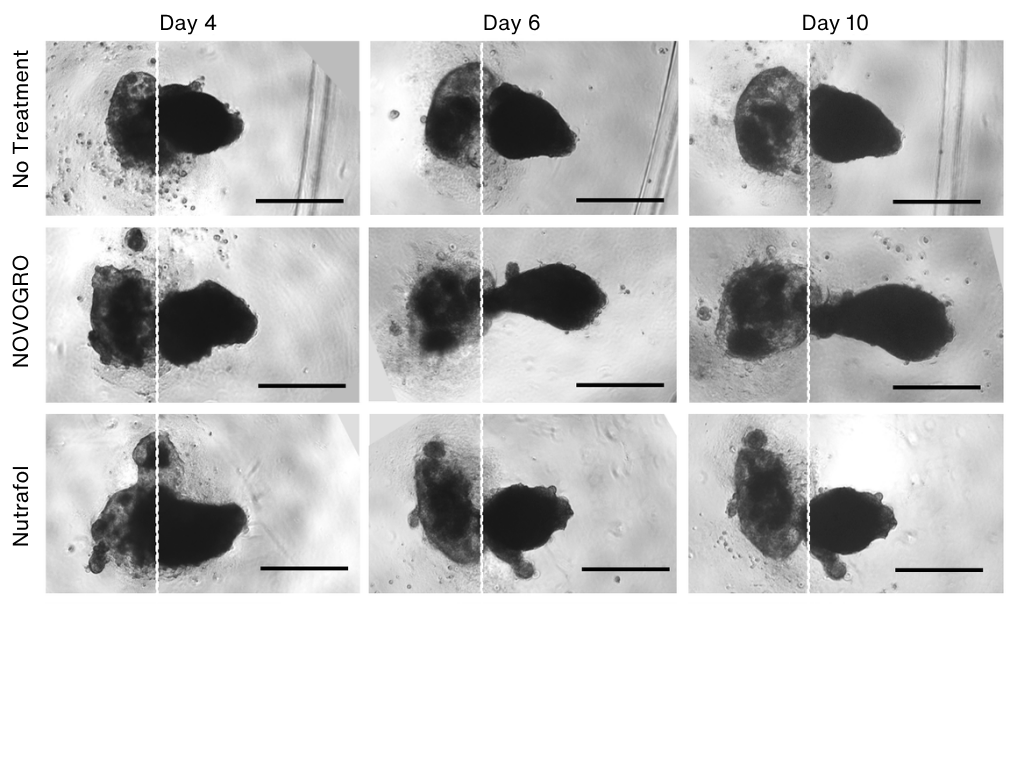
To test that follicle-level activity, researchers behind NOVOGRO™ used a 3D follicloid model, a lab-grown follicle-like structure that helps show how hair-growth behavior changes over time. In this test, the model was treated with different topical serum formulas, including a Nutrafol topical comparator.
They measured elongation, meaning how much the follicle-like structure extended from day 0. As shown below, NOVOGRO™ reached 2.4x elongation, while Nutrafol reached 1.7x.
No treatment
Day 4
Day 6
Day 10
NOVOGRO™
Day 4
Day 6
Day 10
Nutrafol topical comparator
Day 4
Day 6
Day 10
That is the visual readout: the NOVOGRO™-treated follicle model grew farther in the lab.
Preclinical comparison
How far the follicle model grew
Follicloid elongation relative to day 0
This is still preclinical data, so it is not a promise of real-world results on every scalp. It suggests stronger activity than the Nutrafol topical comparator in this model. The finished RE:YOU serum now also has human clinical results to consider.
What the Clinical Data Shows Now
I looked into RE:YOU’s clinical study to see what this looked like on actual scalps. Its serum containing NOVOGRO™ was tested in a randomized, double-blind study of 190 women with visible hair thinning, with daily use over 90 days and a direct minoxidil comparison. RE:YOU reports that 97% experienced less shedding, average shedding fell 56%, and hair density increased 18%. The brand describes the shedding reduction as 44% better than minoxidil.
Why the Study Design Matters
The researchers assessed results through scalp imaging, dermatologist evaluations, standardized comb testing, and participant questionnaires. To me, that is the kind of rigor I want more hair-growth brands to show. I want to know what changed, how it was measured, and whether the results go beyond a convincing before-and-after photo.
Clinical result of NOVOGRO™-powered serum
Experienced less shedding
Share of participants
Average shedding
Change from baseline
Hair density
Change from baseline
The Bottom Line
Nutrafol has a place in the conversation. It is a legitimate supplement brand with strong visibility, a clear wellness angle, and some clinical support, but it is still a supplement. For mild shedding, stress-related changes, or clients who need internal support, it may have a role. Just do not let the branding turn it into something it is not.
NOVOGRO™ is the sharper conversation for clients dealing with visible thinning because it starts closer to the follicle. It is built around molecular discovery, lab validation, multi-pathway targeting, follicle biology, and more solid clinical evaluation.
If the client wants visible density change, part-line improvement, and stronger regrowth, the conversation needs to move closer to the follicle. That is where supplements tap out. RE:YOU’s serum is where I would take that conversation next.